
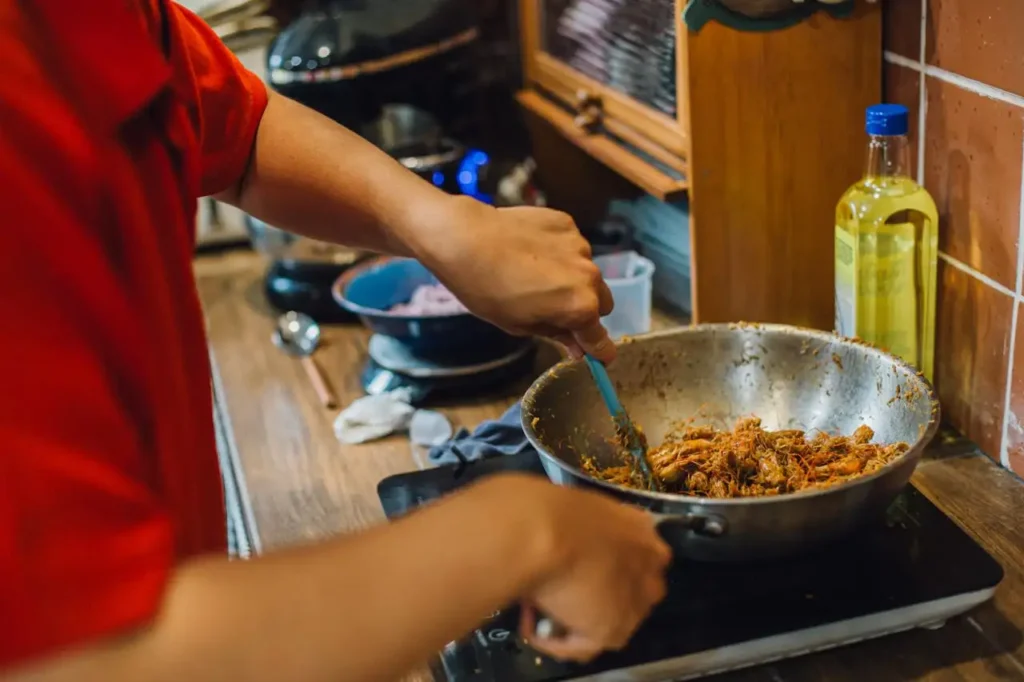
10 Common Cooking Mistakes Beginners Make (And How to Fix Them Fast)
There’s a specific kind of shame that comes with serving rubbery scrambled eggs to someone you wanted to impress. That was me, three years into cooking “regularly,” still making the same cooking mistakes beginners make in week one. Nobody told me the heat was the problem. I just thought eggs hated me.
They didn’t. I was just impatient with the pan.
If you’ve been cooking for a year or two and still hit those moments where something goes wrong and you can’t figure out why, this is for you. Not the “season your food!” basics. The real stuff, with actual explanations.
Table of Contents :
1. Cooking Mistakes Beginners Make With Pan Temperature
The pan isn’t hot enough. Or it’s too hot. Both ruin everything.
Here’s what actually happens: when protein hits a cold pan, it grabs onto the metal surface before the Maillard reaction (the browning chemistry) can form a crust. No crust means it tears, sticks, and steams in its own moisture instead of searing. The result is grey, sad meat.
The fix is the water droplet test. Flick a few drops of water into the pan. If they evaporate immediately — too cold. If they skitter and bounce around like tiny marbles — that’s the Leidenfrost effect, and your pan is ready.
What I do now: I heat the pan for 90 seconds on medium-high before I add anything. Then I add oil, wait 20 more seconds, and then I add food. That 20-second gap matters more than most people realize.
2. Not Drying Ingredients Before Cooking
Wet food steams. Dry food browns. That’s the whole secret.
Moisture on the surface of vegetables or meat converts to steam in the pan, which drops the temperature and prevents caramelization. You end up boiling your food in a frying pan, which is exactly as sad as it sounds.
Pat proteins dry with paper towels before they go anywhere near heat. For vegetables you’ve washed, spread them on a clean dish towel for a few minutes. It feels like an unnecessary step until the first time you do it and your zucchini actually crisps.
Quick Fix: If your stir-fry keeps going soggy, cook in smaller batches. Crowding the pan traps steam. Two batches of properly browned vegetables beat one batch of limp ones every time.
3. The Salt Mistake Most People Don’t See Coming
Most beginner cooks under-salt. But here’s the one nobody talks about: when you salt matters as much as how much.
Salt added at the end of cooking lands on the surface. Salt added during cooking penetrates the food as it cooks, seasoning it from the inside. They taste completely different, even at the same quantity. This is especially true for things like pasta water (it should taste like the sea, not like vague saltiness), braises, and roasted vegetables.
There’s a second layer here too: acid and salt work together. If something tastes flat and you keep adding salt with no improvement, try a squeeze of lemon juice or a small splash of vinegar first. Flat food is often missing brightness, not salt.
4. A Story About Garlic (And Why Timing Is a Cooking Mistake You Keep Making)
I once made a pasta sauce that tasted like pure bitterness. I couldn’t figure it out until a friend watched me cook and said, “You put the garlic in at the beginning and then ignored it for eight minutes.”
Garlic burns at a lower temperature than most people expect, and burnt garlic doesn’t just taste bad — it makes everything around it bitter too. You can’t fix it. The whole base is compromised.
Garlic goes in after your aromatics have had a head start, and it usually needs only 30–60 seconds on medium heat before liquid or other ingredients go in. It should be fragrant and just barely golden. Not brown. Never dark brown.
Onions, by contrast, take 8–10 minutes to soften and sweeten properly. Rushing them is one of the most common cooking mistakes, and it shows up as a harsh, raw edge in the finished dish even when everything else is cooked.
5. Overcrowding the Pan — A Cooking Mistake With a Cumulative Effect
This is the one that stacks. You crowd the pan once and nothing browns. You try to compensate by turning up the heat. Now things burn on the outside and stay raw in the middle. You get frustrated and cover the pan. Now everything steams. Four mistakes from one.
Here’s how to fix it properly, step by step:
- Estimate how much food you’re cooking and mentally double the pan size you think you need.
- Add oil and heat to the correct temperature (water droplet test, see above).
- Add food in a single layer with visible space between pieces.
- Don’t touch it for 2–3 minutes. Let the crust form.
- If cooking in batches, keep finished pieces warm in a 200°F oven while the rest catches up.
The reason this works is surface area contact. Each piece needs direct contact with the hot pan surface to brown. Stack them and you’re just heating a pile of food, not cooking it.
6. Tasting as You Go — Or Rather, Not Doing It
This one’s less about a specific fixing-cooking-mistakes technique and more about a habit that changes everything.
Professional cooks taste constantly. Every time something goes into the pot. Before and after each major addition. Before it goes on the plate. Most home cooks taste once, at the end, and then try to fix everything at once — which is how you end up over-salting a dish that just needed acid, or adding more spice to something that was actually fine and just needed to finish cooking.
Build the habit of tasting with a clean spoon at each stage. You’ll start to understand what “needs something” actually means, and you’ll catch problems early enough to actually fix them. This is honestly the skill that separates cooks who improve quickly from those who plateau.
how professional kitchens approach seasoning and tasting
7. Using the Wrong Knife (Or a Dull One) — A Mistake That Affects Everything Upstream
Most beginner cooks own one decent knife and use it for everything. That’s fine. But if that knife is dull, every single thing you cook starts with a handicap.
A dull knife doesn’t just make cutting harder — it actually changes how your food cooks. When you crush a tomato instead of slicing through it, you lose juice onto the cutting board before the tomato ever hits the pan. When you hack at an onion instead of slicing cleanly, you rupture more cells, releasing more of the compounds that make your eyes water and making the onion taste sharper and more pungent in the finished dish.
There’s also the safety issue that nobody talks about clearly enough: a dull knife requires more pressure, which means when it slips — and it will — it goes somewhere fast.
What I do now: I run my chef’s knife across a honing steel before almost every use. Takes 10 seconds. Honing realigns the edge without removing metal (that’s what sharpening does). You don’t need to sharpen often. You do need to hone regularly. The difference in how the knife feels after is immediate and obvious.
Quick Fix: If your knife feels dull right now and you don’t have a honing steel, fold a piece of aluminum foil several times and slice through it a few times at a 20-degree angle. It’s not a substitute for proper honing, but it’ll take the wire edge off in a pinch.
8. Mis-reading Recipe Instructions — Especially “Prep” Steps
Here’s a specific failure I see constantly, including in my own early cooking: the recipe says “1 cup chopped walnuts” and you measure a cup of whole walnuts, then chop them.
That gives you about 1.5–2 cups of chopped walnuts. The baked good or sauce you’re making is now out of balance.
The rule is simple but not obvious until someone explains it: the instruction before the comma tells you what to do first. “1 cup chopped walnuts” means chop, then measure. “1 cup walnuts, chopped” means measure, then chop. Same words, different order, meaningfully different amounts.
This same logic applies to things like “2 tablespoons butter, melted” versus “2 tablespoons melted butter.” The first gives you slightly more butter. Doesn’t matter in a pan sauce. Matters a lot in a delicate cake.
It’s not a dramatic mistake. It’s the kind of thing that makes your baking almost right but never quite nails it — and you can never figure out why.
How to Read a Recipe Properly Before Cooking (Avoid Common Mistakes)
9. Not Letting Meat Rest — And Misunderstanding Why It Matters
You’ve probably heard “let the meat rest.” Most beginners hear it and think it’s about letting the meat cool down slightly so it doesn’t burn your mouth. That’s not why.
Here’s what’s actually happening: heat drives moisture toward the center of the meat as it cooks. The outer layers tighten and push liquid inward. When you cut into it immediately, that centrally pooled liquid runs straight out onto the cutting board. You didn’t lose the juice during cooking — you lost it in the last 60 seconds of impatience.
When you rest the meat, the muscle fibers gradually relax and reabsorb that liquid as the internal temperature equalizes. The result is a noticeably juicier bite, not because you did anything during cooking, but because you waited afterward.
How long to rest depends on size:
- Thin cuts like chicken breast or pork chops — 3 to 5 minutes, loosely tented with foil.
- A whole chicken or duck — 10 to 15 minutes.
- A large roast or prime rib — 20 to 30 minutes. The internal temperature will actually continue rising 5–10°F during this time (called carryover cooking), so factor that into when you pull it from heat.
One thing nobody mentions: resting on a wire rack instead of a plate keeps the bottom crust from steaming itself soggy while the meat sits. Small detail. Real difference.
10. Treating Every Stovetop Burner — and Every Oven — Like It’s Calibrated Correctly
This is the cooking mistake that makes beginners doubt their own skills when the actual problem is their equipment.
Most home ovens run 25–50°F off from what the dial says. Some run hotter, some cooler, and almost none of them heat evenly — there are hot spots, usually toward the back or one side. Your stovetop burners aren’t consistent either. “Medium” on one burner isn’t the same as “medium” on another, and definitely isn’t the same as medium on anyone else’s stove.
This is why recipes don’t always work as written, and why something that took 25 minutes at a friend’s place takes 35 minutes at yours.
The fix isn’t complicated, but it does require one small investment:
- Buy an oven thermometer (they cost about $8–12) and hang it inside your oven.
- Preheat to 350°F and check what the thermometer actually reads after 20 minutes.
- Adjust your dial accordingly — if the thermometer reads 325°F, you know to set your oven 25 degrees higher than any recipe calls for.
- For stovetop, spend one session just heating a pan of water on each burner at different settings and noting how quickly it simmers. It sounds tedious. You only have to do it once.
The reason this matters so much for beginners specifically is that you’re still building intuition. When your equipment is giving you wrong information, you can’t trust your own read on what went wrong. An oven thermometer doesn’t just fix your baking — it helps you learn faster, because you’re finally working with accurate feedback.
FAQ
What are the most common cooking mistakes beginners make? The most common are using a pan that’s too cold, not drying ingredients before cooking, under-seasoning early, and crowding the pan. Each one prevents browning and layers of flavor that make food taste restaurant-quality.
How do I fix cooking mistakes once the dish is already made? It depends on the problem. Over-salted food can sometimes be fixed by adding a starch (potato, extra pasta) or acid. Bland food needs salt and acid. Bitter food from burnt garlic usually can’t be saved — start the base over if you can.
Why does my food always come out soggy instead of crispy? Usually excess moisture or an overcrowded pan. Pat food dry before cooking, cook in smaller batches, and make sure the pan is properly preheated. Soggy food is almost always a steam problem, not a seasoning one.
Is there a cooking mistakes beginners list I can keep in the kitchen? The most useful short version: dry your food, heat your pan, don’t crowd it, salt in layers, and taste as you go. Those five cover about 80% of common problems.
When should I add garlic while cooking? After your onions or base vegetables have softened, not at the start. Garlic needs 30–60 seconds on medium heat and burns easily. Add it near the end of building your base, right before liquid or other ingredients go in.
Did you love this recipe?
Share it with your friends & family!
Leave a Comment