
The Science of Flavor: Understanding the Maillard Reaction in Cooking
There’s a specific kind of disappointment that comes from pulling a chicken breast out of the pan and realizing it’s gray. Not golden, not even pale brown. Gray. I’d done everything the recipe said, but somehow the piece of chicken I’d been excited about looked like it had been boiled, not seared. That was my introduction, the hard way, to the Maillard reaction in cooking, and why ignoring the conditions it needs will quietly ruin your food every single time.
The Maillard reaction is named after French chemist Louis-Camille Maillard, who first described it in 1912. At its core, it’s a chemical reaction between amino acids and reducing sugars that happens when food is exposed to enough heat. The result is hundreds of new flavor compounds, that signature brown crust, and the kind of aroma that makes people wander into the kitchen asking “what’s cooking?” It’s behind the crust on bread, the sear on a steak, the color on roasted coffee beans, and that specific smell when butter hits a hot pan.
Understanding it changed how I cook. Not dramatically. Just fundamentally.
Table of Contents :
Why the Maillard Reaction in Cooking Fails Before It Even Starts
Most home cooks lose the Maillard reaction before the food even hits the pan, and it almost always comes down to one thing: water.
The reaction needs surface temperature to hit roughly 280°F to 330°F (140°C to 165°C) before it really kicks in. Water boils at 212°F. So any moisture sitting on the surface of your protein is essentially creating a ceiling, a thermal barrier that keeps your food steaming instead of browning. You can have a scorching hot pan and still end up with gray chicken, because the heat is all going into evaporating the surface moisture first.
This is why patting food dry isn’t just a tidying step. It’s removing the thing that will actively prevent browning from happening. Wet surface equals steam equals no crust.
The same logic applies to crowding the pan. Each piece of food releases moisture as it cooks. Pack too many pieces together and you’ve essentially created a steam environment. The pan can’t recover its heat fast enough, the moisture can’t escape fast enough, and the Maillard reaction never gets traction.
Quick Fix: Before searing any protein, press it firmly between two paper towels for about 30 seconds. Then let it sit uncovered in the fridge for 20 minutes if you have time. The surface will dry out noticeably, and the difference in browning is immediate.
The Temperature Reality: What “Hot Pan” Actually Means
“Get your pan really hot” is advice that appears on roughly every cooking site, and it’s not wrong, it’s just incomplete. Hot relative to what? For how long? Here’s what I’ve actually measured and timed.
A cast iron pan set to medium-high on a gas burner needs about 4 to 5 minutes to fully preheat, not 90 seconds. I know because I used an infrared thermometer obsessively for about three months after I couldn’t figure out why my steaks weren’t browning properly. The pan felt hot to a water-drop test after 2 minutes, but the surface temperature was still only around 240°F in the center. Too low.
The sweet spot for most pan searing is 350°F to 400°F at the surface. High enough to trigger the Maillard reaction fast, low enough that you’re not burning the exterior before the interior cooks. This is also why oil choice matters: you need a fat with a smoke point that sits above your target surface temperature. Butter alone will burn and turn bitter before you hit proper searing temps. If you want butter flavor, start with a neutral high-smoke-point oil and add butter in the last minute or two.
One thing almost no one talks about: preheating time changes significantly with pan material. Stainless steel heats faster but has more hot spots. Cast iron heats slower but holds temperature far more evenly. For the Maillard reaction, you want evenness more than speed, which is one reason cast iron and carbon steel produce better sears for most home cooks.
Maillard Reaction vs. Caramelization: They’re Not the Same Thing
I confused these for years. Like, genuinely thought they were two names for the same process.
They’re not. Caramelization is the browning of sugar alone, through heat. It starts around 320°F for fructose and closer to 340°F for sucrose. No protein involved. The flavor compounds it produces are different: sweeter, slightly bitter, more candy-like.
The Maillard reaction requires both amino acids and reducing sugars reacting together. It starts at a lower temperature range and produces dramatically more complex flavor compounds, often described as savory, roasted, or nutty depending on the food. It’s why browned butter smells different from caramel. It’s why bread crust tastes different from candy.
Both can happen simultaneously, especially in foods that contain both sugar and protein. Milk, for example, browns through both mechanisms at once. Understanding the difference matters because it helps you predict what a food will do: pure sucrose caramelizes, a lean protein without sugars undergoes Maillard, and a glazed piece of pork with a honey marinade is doing both at the same time.
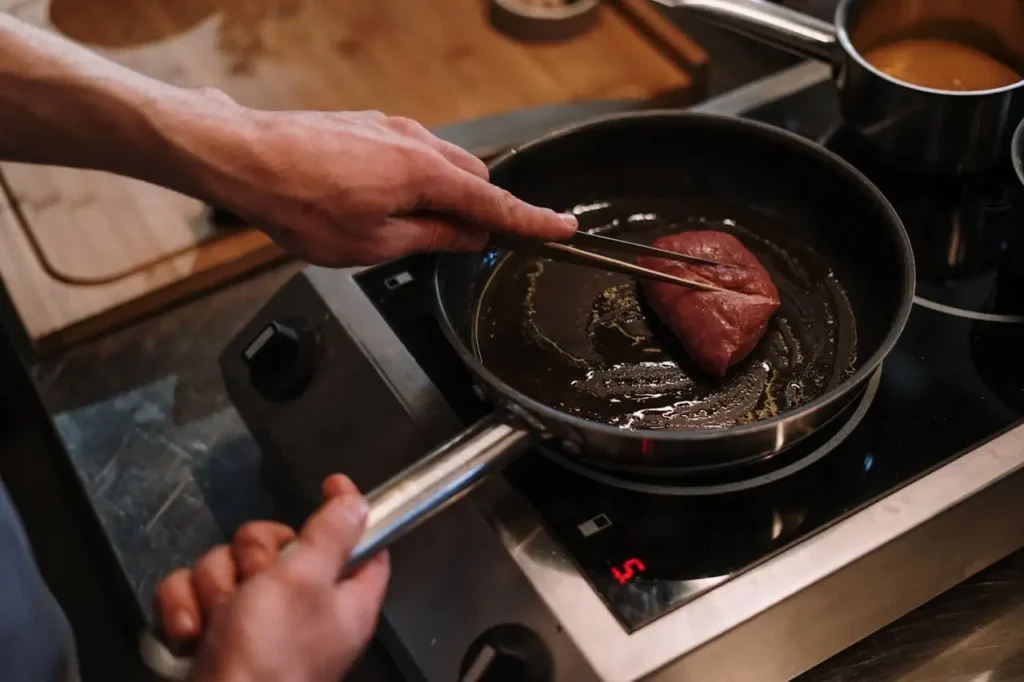
How to Actually Set Up Your Pan for a Better Sear
This is the step-by-step I wish someone had given me instead of “hot pan, dry food.”
- Pat your protein completely dry with paper towels. Press, don’t just blot.
- Season with salt at least 45 minutes before cooking, or right before. Salting in between pulls moisture to the surface and gives it nowhere to go.
- Preheat your pan over medium-high heat for 4 to 5 minutes. Test with a drop of water. It should bead and evaporate in under 2 seconds.
- Add oil with a high smoke point (avocado, refined sunflower, or neutral vegetable oil) and let it shimmer, about 30 seconds.
- Add the protein without moving it. Press it flat gently for contact. Leave it alone for 3 to 4 minutes.
- It releases easily when it’s ready. If it sticks and resists, it hasn’t formed a crust yet. Wait 30 more seconds before trying again.
That last point is the one I had to learn through ruined crusts before I understood it. The Maillard crust is actually what releases the protein from the pan. Fight it before then and you’re breaking apart something that needed more time.
The Variable Nobody Warned Me About: pH and Sugar Content
Here’s the part other articles almost never get into.
The Maillard reaction is sensitive to pH. Slightly alkaline environments accelerate it significantly. This is actually the reason pretzels get dipped in a lye solution (or baking soda solution for home baking) before they go in the oven. The alkalinity speeds up browning and deepens flavor.
You can use this in everyday cooking. Adding a tiny pinch of baking soda (about an eighth of a teaspoon per pound) to ground meat, or to onions you’re caramelizing, speeds up Maillard browning noticeably. The onions go from pale to deeply browned in roughly half the time. Too much and you’ll taste it, so this is not a “more is better” situation. But a small amount works genuinely well.
The same principle explains why a buttermilk marinade or a yogurt-marinated chicken doesn’t brown quite as fast as an unmarinated one. The acidity slows the reaction slightly. Not a reason to skip marinades, just a reason to make sure you’re patting them off really well before hitting the heat.
What I Do Now: Before I cook burgers, I mix in about a quarter teaspoon of baking soda per pound of beef and let it sit for 10 minutes. The difference in crust formation is visible and the flavor is noticeably deeper. It’s one of those adjustments that feels small but becomes automatic once you’ve seen what it does.
Is the Maillard Reaction Something to Worry About?
People ask whether heavily browned food is unhealthy, and it’s worth answering honestly. The concern is usually about acrylamide, a compound that forms through Maillard-related reactions in starchy foods at very high temperatures. Some studies have flagged it as a potential concern in large quantities.
In practice, for normal home cooking at normal searing temperatures, the risk is considered minimal by most food safety bodies. The issue is more relevant to industrial processing or to consistently burning food, not to achieving a proper sear on a piece of chicken.
The difference between browned and burned matters both for flavor and for this question. A proper Maillard crust is deep golden to dark brown. Blackened or charred consistently crosses into a different category of compounds. Cooking to USDA-recommended internal temperatures while aiming for surface browning, not scorching, is the practical answer here.
Some cooks find that switching to lower-heat methods for certain foods, like reverse searing a steak before a quick high-heat finish, gives them the best of both: proper internal doneness and a fast, controlled Maillard crust without prolonged high heat exposure.
FAQ
What temperature does the Maillard reaction occur at in cooking?
The Maillard reaction begins at approximately 280°F (140°C) and accelerates up to around 330°F (165°C) at the food’s surface. This is why surface moisture matters so much: water keeps the surface temperature capped at 212°F, preventing browning until it fully evaporates.
Is the Maillard reaction unhealthy?
For most home cooking purposes, no. The concern around acrylamide, a compound linked to Maillard-type reactions, is largely relevant to starchy foods cooked at very high temperatures for extended periods. A well-browned sear on meat or a toasted piece of bread falls well within what food safety authorities consider acceptable.
What’s the difference between the Maillard reaction and caramelization?
Caramelization involves only sugar breaking down under heat, producing sweet, slightly bitter flavor compounds. The Maillard reaction requires both amino acids and reducing sugars reacting together, and it produces a much wider range of savory, roasted flavor compounds. Both can happen at once in foods that contain protein and sugar.
How long does the Maillard reaction take when searing meat?
With proper conditions, meaning a dry surface and a fully preheated pan, a visible Maillard crust typically forms in 3 to 4 minutes per side over medium-high heat. If browning isn’t happening within 5 minutes, the surface is too wet, the pan isn’t hot enough, or the pan is overcrowded.
Why is my steak brown on the outside but not forming a real crust?
This usually means the pan wasn’t hot enough, the steak surface was too wet, or both. Without enough surface heat, the protein cooks through without triggering the Maillard reaction’s crust formation. Pat the steak completely dry, preheat your pan longer than feels necessary, and don’t move the steak for at least 3 minutes after it goes in.
You Can Check Also :
How to Cook Chicken Perfectly Every Time (Juicy, Tender & Never Dry)
10 Common Cooking Mistakes Beginners Make (And How to Fix Them Fast)
Once you understand why browning happens, you stop guessing. The gray chicken doesn’t feel random anymore. It has a cause you can fix in about 30 seconds of preparation. Most of the flavor you’re chasing in seared meat, crusty bread, and roasted vegetables comes down to this one reaction getting the conditions it needs. Give it those conditions and the results start to feel a lot more consistent.
Did you love this recipe?
Share it with your friends & family!

Leave a Comment