
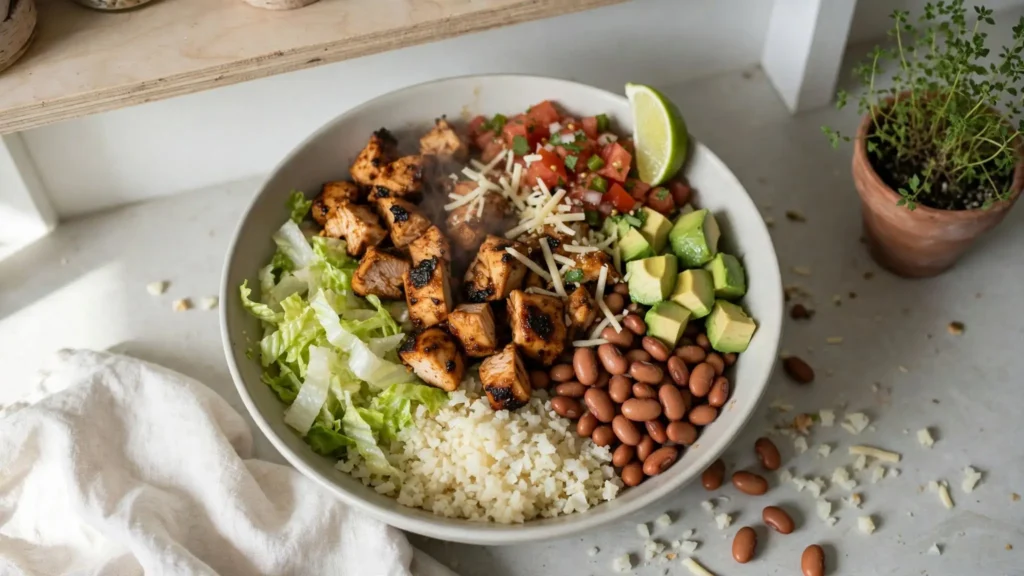
Healthy Chicken Burrito Bowls with Cauliflower Rice
The weak link in most cauliflower-rice bowls is the base. When it turns watery or mushy, everything on top of it suffers. These healthy chicken burrito bowls get around that by cooking each component on its own: chipotle-glazed chicken, skillet cauliflower rice, and a row of fresh toppings that stay separate until you serve.
This is an assembly recipe, so most of the work is knowing what to cook, what to measure, and what to keep apart. The chicken goes under the broiler, the cauliflower cooks in a skillet, and the rest is chopping and portioning.
Table of Contents :
Quick Recipe Snapshot
- Servings: 4 bowls
- Category: Main course, composed bowl
- Chicken: 1 pound raw boneless, skinless chicken breasts (weights in this recipe refer to raw chicken unless noted)
- Cauliflower rice: ½ cup cooked per bowl
- Chicken doneness: 165°F (74°C) in the thickest part
What Matters Most for This Recipe
Two decisions keep these bowls on track: how you judge the chicken, and how you treat the cauliflower.
Trust the thermometer, not the timer. The broiling times below are a guide. Ovens, pan placement, and the thickness of the chicken all shift the real finish line. The only reliable endpoint is 165°F (74°C), measured in the thickest part of the chicken. Browning doesn’t tell you the chicken is safe, so don’t skip this check.
Keep the components separate. Cook the chicken and cauliflower apart and combine them only in the bowl. That keeps the cauliflower from picking up liquid from the other ingredients, and every layer stays distinct.
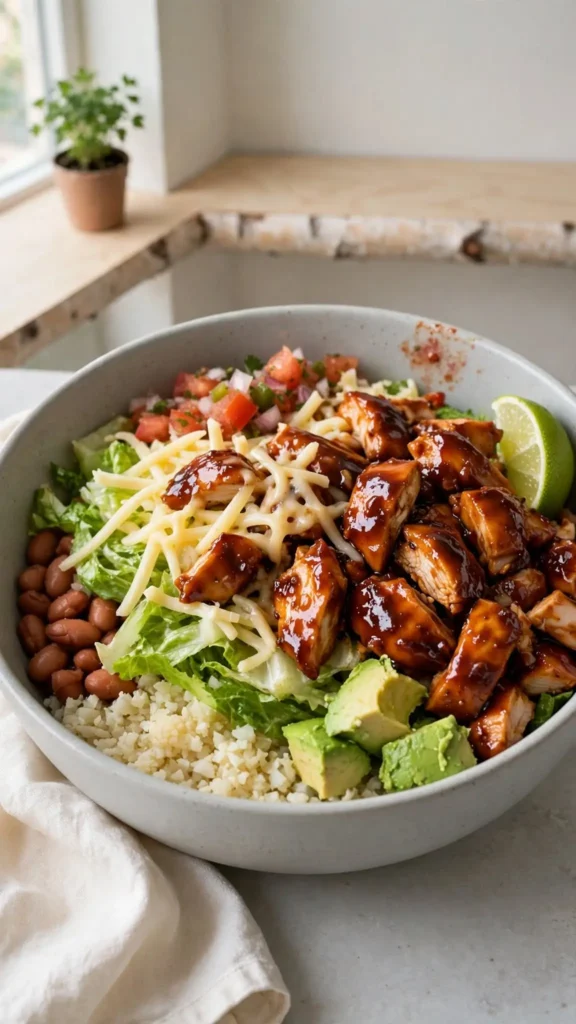
Ingredients For Healthy Chicken Burrito Bowls
For the cauliflower rice
- Cauliflower, enough to make four ½-cup cooked portions (2 cups cooked in total)
- 2 tablespoons extra-virgin olive oil (from the 3 tablespoons total)
- ¼ teaspoon salt (from the ½ teaspoon total)
For the chipotle chicken
- 1 pound raw boneless, skinless chicken breasts
- ¼ teaspoon salt (the remaining half of the ½ teaspoon total)
- 1 tablespoon extra-virgin olive oil (the remaining 1 tablespoon of the 3 tablespoons total)
- 1 tablespoon finely chopped chipotle peppers in adobo
- ½ teaspoon garlic powder
- ½ teaspoon ground cumin
For the bowls
- 2 cups shredded romaine
- 1 cup rinsed canned pinto beans (¼ cup per bowl)
- 1 ripe avocado, diced
- ¼ cup pico de gallo
- ¼ cup shredded Monterey Jack cheese
- Lime wedges, optional
Ingredient Notes
Olive oil is divided. Two tablespoons go into the cauliflower and one tablespoon goes into the chipotle glaze for the chicken.
Salt is divided too. ¼ teaspoon goes into the cauliflower and the remaining ¼ teaspoon seasons the chicken.
Check your labels. The chipotle, pico de gallo, beans, and cheese all vary by brand. If you’re watching sodium, added sugar, or gluten, check the packaging on each. The recipe contains dairy because of the Monterey Jack.
Equipment
- Food thermometer: the only dependable way to confirm the chicken is done.
- Large skillet: for cooking the cauliflower rice.
- Rimmed baking sheet that is safe under the broiler: for the chicken.
- Food processor: to pulse the cauliflower into rice-sized pieces.
How to Make Healthy Chicken Burrito Bowls
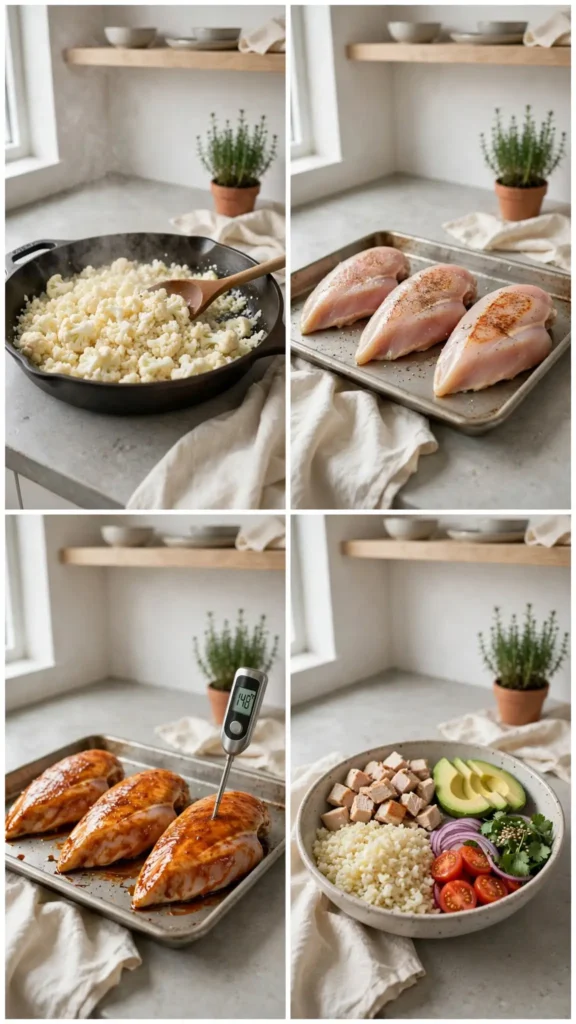
- Make the cauliflower rice. Pulse the cauliflower in a food processor until the pieces are about the size of rice grains. Heat a large skillet over medium-high heat with 2 tablespoons of the olive oil and ¼ teaspoon of the salt. Add the cauliflower and cook until softened, about 5 minutes. Softened is the goal here, not browned or crisp. If liquid is pooling in the pan or the cauliflower looks mushy, you’ve gone too far.
- Heat the broiler. Position an oven rack in the upper third of the oven and preheat the broiler to high. Set the chicken on a rimmed baking sheet.
- Broil the chicken. Season the chicken with the remaining ¼ teaspoon salt and broil for 9 minutes.
- Make the glaze. While the chicken broils, stir together the remaining 1 tablespoon olive oil, the chipotle, garlic powder, and cumin.
- Turn and glaze. Turn the chicken and spread the chipotle mixture over it.
- Finish cooking. Continue broiling for about 8 to 10 more minutes, using that range only as a guide. Check the thickest part with a thermometer. If it reads under 165°F (74°C), keep cooking and check again.
- Chop the chicken. Chop the cooked chicken into bite-sized pieces.
- Assemble. Divide the cauliflower rice among four bowls, about ½ cup each. Add the chopped chicken, then arrange the romaine, ¼ cup of the pinto beans, diced avocado, pico de gallo, and Monterey Jack in separate sections. Serve with lime wedges if you like.
Substitutions
| Original | Substitute | What changes |
|---|---|---|
| Freshly broiled chicken | Shredded store-bought roasted chicken | Saves the cooking step, but the seasoning, sodium, fat, and portion weight will differ from the recipe as written. |
| Pinto beans | Black beans | Works as a bowl component. Texture and moisture may differ slightly, and the nutrition will not be identical. |
| Fresh cauliflower | Frozen cauliflower rice | Not a one-for-one swap. This recipe’s timing is written for fresh cauliflower, and frozen bagged rice is the version people most often complain turns soggy. |
Variations
Fajita-style bowl. Swap the chipotle glaze for a fajita seasoning and build the bowl with corn, tomatoes, black beans, and salsa. This changes both the flavor and the composition, so it needs its own quantities rather than the ones above.
Convenience bowl. Use roasted chicken, canned beans, prepared salsa, and prepared guacamole to cut down the from-scratch work. Record the quantities and read the labels yourself, since they won’t match the recipe above.
Troubleshooting
Problem: the cauliflower rice turns soggy.
Excess liquid and a mushy texture are the warning signs. Frozen bagged cauliflower rice is the version most often blamed for it. This recipe is written around fresh cauliflower, so start there. There’s no tested rescue for already-soggy rice here, so the best prevention is stopping once it has softened.
Problem: the chicken is done by the timer but not by the thermometer.
Broiler times are a guide. Keep cooking until the thickest part reaches 165°F (74°C).
Problem: meal-prep food sat out too long.
Reheating doesn’t reliably undo unsafe holding time, and smell is not a safe test. Track the clock instead.
Storage and Reheating
Refrigerator. Refrigerate cooked components within 2 hours of cooking. If you let food cool before putting lids on to limit condensation, keep an eye on the clock, because that cooling time counts toward the 2 hours. Don’t leave it sitting out until it reaches room temperature.
How long it keeps. USDA guidance allows refrigerated leftovers for 3 to 4 days. UK guidance is more conservative at 48 hours. For a simple rule, eat the bowls within 2 days or freeze them.
Freezer. USDA gives 3 to 4 months for frozen leftovers. That figure covers safety, not texture, and it says nothing about how romaine, avocado, or an assembled bowl hold up, so keep the fresh toppings out of the freezer.
Thawing and reheating. Reheat leftovers to 165°F (74°C). If you thaw in the microwave, continue heating to 165°F straight away.
What to Serve with It
The bowl is a complete meal on its own. Lime wedges, extra pico de gallo, or a little more avocado are easy additions.
FAQ
Why is my frozen cauliflower rice soggy?
Frozen bagged cauliflower rice is the version people most often report as watery. A reliable fix hasn’t been established, so this recipe uses fresh cauliflower and doesn’t offer timing for frozen. If you try frozen, watch the pan for pooling liquid and stop when the texture is soft rather than mushy.
Can chicken burrito bowls be made for meal prep?
Yes, with limits. Cook the components separately, refrigerate them within 2 hours, and plan to eat them within 2 days (or freeze them). USDA guidance allows 3 to 4 days, but the 2-day rule is the more conservative choice. Reheat leftovers to 165°F (74°C).
Can I use store-bought roasted chicken and prepared toppings?
Yes. It’s a legitimate shortcut that saves cooking time. Just know it changes the seasoning, sodium, and portion weight compared to the recipe above, so check the labels.
You Might Also Like :
20-Minute Chicken Fajita Skillet
Final Notes
Three things carry this recipe: cook the components separately, stop the cauliflower when it’s softened, and let a thermometer reading of 165°F (74°C) decide when the chicken is done.
Did you love this recipe?
Share it with your friends & family!
Leave a Comment