
Basic Knife Skills for Beginners (How to Chop, Dice and Slice)
Knife skills for beginners usually start with a sound you probably know: an onion skittering across the cutting board right as your nerves kick in. If your pieces come out uneven, your food keeps sliding, and your guide hand hovers a little too close to the blade, you’re not bad at this. You’re just missing a system. Most guides hand you a list of cuts and skip the part that actually matters. So here’s the one I use: stable food, protected hand, guided blade. Get those three right and slicing, chopping, and dicing start to feel like the same motion with different endings (really, that’s the whole secret).
Table of Contents :
What Are Basic Knife Skills for Beginners?
Basic knife skills for beginners are three habits: keep the food still, keep your fingertips out of the blade’s path, and let the blade follow a controlled line. Cut names come later. A dice and a slice are just those same habits repeated in a different pattern.
Here’s why I teach it in this order. When food rocks or rolls, you spend the whole cut chasing it, and that’s when the blade drifts. When your fingertips stick out, the blade has nowhere safe to go. And when you rely on brute force instead of control, your hand tires fast and your pieces come out wobbly.
Fix the habits first and the cuts take care of themselves. The sensory check is simple: before every cut, the food should sit on the board like a tiny block that isn’t going anywhere.
How Do You Hold a Knife and Protect Your Fingers?
You hold the knife with a pinch grip in your cutting hand and curl your other hand into a claw grip to guide the blade. Two hands, two jobs, and neither one is “squeeze as hard as you can.”
The Pinch Grip
The pinch grip means gripping the blade right where it meets the handle, with your thumb and forefinger on either side, while your remaining fingers wrap the handle. Pinching puts your hand closer to the blade, which gives you leverage and control. Gripping only the handle leaves the blade swinging out in front of you like a pendulum.
You’ll feel the difference right away. The knife stops feeling like something you’re pushing around and starts feeling like an extension of your hand. If your forearm aches halfway through an onion, loosen your grip and let the pinch do the steering.
The Claw Grip
The claw grip means curling the fingertips of your guide hand inward, behind your knuckles, so the flat side of the blade can rest against the knuckles as it cuts. Your fingertips stay tucked away, and the knuckles physically steer the blade away from them. That’s why this grip protects you so well.
The most common mistake is the flat-finger hover, where the fingers lie straight along the food. It feels natural, and it puts fingertips exactly where the blade is headed. If you can see your fingernails from above, curl them under until you can’t.
One more habit that’s easy to overlook: keep the blade pointed away from your body when you cut, wash, or dry a knife. (Washing is where a lot of kitchen nicks happen, since the knife is out of “cutting mode” and your guard is down.)
How Do You Slice, Chop, and Dice?
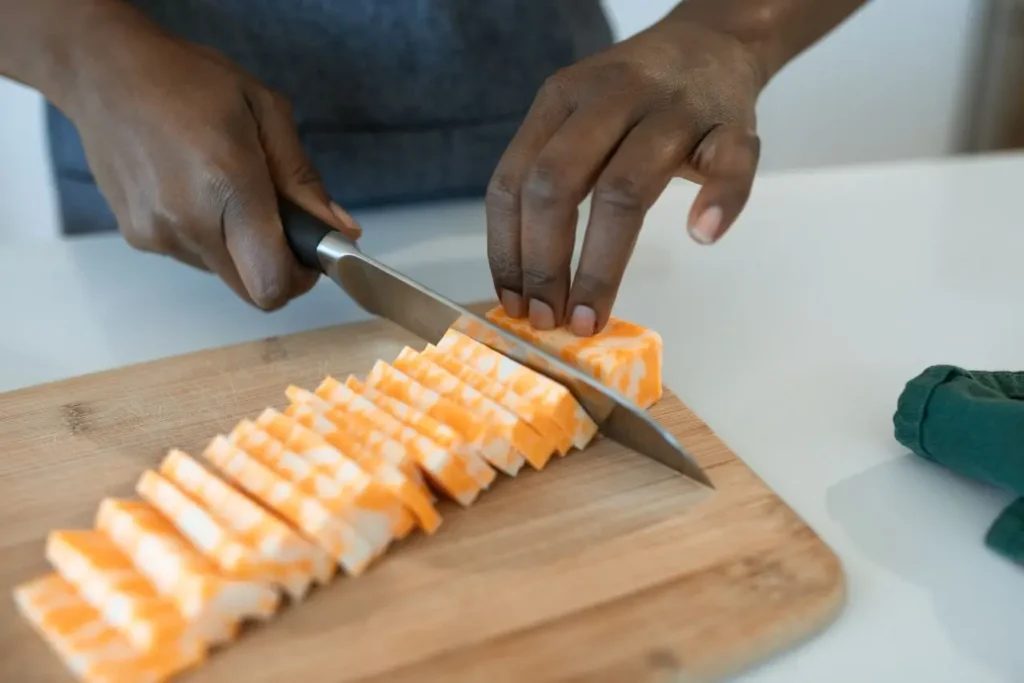
To slice, chop, or dice, give the food a flat face, anchor it with your claw grip, and let the blade glide along your knuckles. Here’s the repeatable sequence I use for every cut, with an onion, carrot, or celery stalk:
- Make a flat face. Halve the food, or trim a thin slice off one side so it rests level.
- Set it flat on the board. Give it a gentle nudge. If it rocks, flip it and check the base again.
- Curl your guide hand into a claw. Fingertips tucked behind the knuckles.
- Pinch the blade. Thumb and forefinger at the blade-handle junction, remaining fingers around the handle.
- Cut with a smooth stroke. The side of the blade lightly touches your knuckles. Move the guide hand back a little after each cut and repeat.
Once you can do that sequence, the three cuts are just three different goals.
Slice
Slicing is the cleanest version of the sequence: long, smooth strokes with as little downward pressure as you can manage. For delicate produce and herbs, a slicing motion keeps you from crushing or bruising them. You’re watching for a clean, bright cut edge, not a squashed, wet one.
Chop
Chopping is the rough, forgiving cut. You’re breaking food into bite-sized pieces without caring if every piece matches. It’s a great place to build rhythm (celery is perfect for this), because nobody’s grading your pieces. Keep the same flat face and the same claw, and let your hands settle into a pattern.
Dice
Dicing is chopping with discipline. A dice produces smaller, more uniform pieces than a rough chop, and mincing goes finer still. For an onion, cut it into even strips first, then turn those strips and cut across them. Uniform pieces cook at the same pace, which means no raw bits next to burnt ones. Focus on consistency before speed, every single time.
Why Does My Food Move or My Cuts Look Uneven?
Your food moves or your cuts look uneven because of one of three problems: an unstable base, a weak grip, or too much downward force. Let’s compare them side by side, because each one feels different in your hands.
Unstable base. The food rolls or rocks when you start the cut. Nothing you do with the knife can fix this, since the food itself isn’t cooperating. You’ll hear it too, a little clatter as the piece shifts.
Poor grip. Your fingers hover flat, or you’re gripping only the handle. The blade wanders because nothing is guiding it, and your fingertips are closer to danger than they should be.
Too much force. You’re pressing straight down hard and the knife skids or the food squishes. A dull blade makes this worse, because it needs more pressure to cut and a slip becomes more likely. When you notice you’re pushing, the knife is usually asking for a reset, not more muscle.
Here’s the principle that ties all three together, and it’s the most useful thing I can tell you: beginner cuts become consistent when the food is stabilized with a flat face and your knuckles act as a physical guide rail for the blade, not when you try to control the knife with finger strength. Stop gripping harder. Set the food up so the cut is easy, then let the knuckles do the guiding.
Make a Flat Face First
A flat face is a level surface you create before the first real cut. Halve a round food, or slice a thin piece off the bottom, and set the flat side down. Round foods want to roll. A flat base removes that option, so the food stays put through every cut. It takes a few seconds and saves you a lot of chasing.
Use Your Knuckles as a Guide
Your knuckles are your built-in rail. With fingertips curled behind them, the side of the blade lightly meets the knuckles as it moves, and the blade follows a consistent path. Listen for a steady rhythm. If your cuts sound choppy and irregular, check whether your knuckles are really in contact with the blade or hovering out of reach.
Quick Fix: Stop mid-cut, set the knife down, and make a flat face on the food. Reset your claw grip so your fingertips are tucked behind your knuckles, then slow the stroke way down and let the blade touch your knuckles.
What Knife Skills for Beginners Should You Practice First?
Practice stable placement and knuckle guidance first, and leave speed for later. The best way I know to build real knife skills for beginners is repeating the same setup on one cheap, forgiving vegetable until the motion feels boring (boring is the goal).
A good progression looks like this: start with a carrot or an onion, make the flat face, and practice plain slices. Once those feel steady, move to chopping, then to dicing. Don’t rush the order, because each cut builds on the habits from the one before. Skip any urge to track your speed. Smooth now becomes fast later.
What I do now is create the flat face before anything else, then take my first few cuts slowly with my knuckles touching the blade. It sounds small, but it sets my whole rhythm for the rest of the vegetable, and it’s the habit that keeps my pieces even when I’m cooking on autopilot.
Keep your safety habits in the routine too. Blade away from your body, claw grip every time, and a calm pace. If a piece is wobbling, stop and fix the base. Nothing in this practice needs a fancy knife, just a clean cutting surface and a little patience.
Frequently Asked Questions
How do you hold a knife for beginners?
Use a pinch grip: thumb and forefinger on either side of the blade where it meets the handle, with your remaining fingers wrapped around the handle. That position puts your hand closer to the blade, so you steer with control instead of squeezing harder. Keep your other hand in a claw grip, and the knife starts to feel balanced.
Can you chop vegetables without a cutting board?
No, not for routine prep. A stable cutting board gives your food a firm, predictable surface, and controlled cuts get much harder on anything that shifts. If your board slides around, anchor it, for example by placing a damp towel under it, before you start.
Is a dull knife safer than a sharp knife?
No, that’s a common myth. A dull blade needs more pressure to cut, which reduces your control and raises the chance of a slip. Keep your knife sharp rather than relying on dullness for safety.
How small should diced vegetables be?
It depends on the recipe, but uniformity matters more than hitting an exact size. For many dishes, pea-sized dice is a good visual reference. Pieces that match each other cook evenly, so aim for consistent, not perfect.
Why does my onion move while I’m cutting it?
Your onion moves because it doesn’t have a flat base. Halve it, or trim a thin slice off one side so it rests level, then use your claw grip and let the blade follow your knuckles. Once the onion stops rocking, the rest of the cut gets noticeably easier.
You Might Also Like :
Common Ingredient Substitutions for Home Cooks
How to Thaw Chicken Safely (3 Fast Methods)
How to Cook Rice on the Stove: Fluffy, Not Gummy
Once you stop fighting your food and start guiding the blade, chopping gets a lot calmer, and dinner prep stops feeling like a test. Tell me in the comments which cut still gives you trouble, and I’ll help you troubleshoot it.
Did you love this recipe?
Share it with your friends & family!

Leave a Comment